
Introduction
Nearly every business — from hospitals and banks to retailers and event planners — relies on printed materials to communicate with customers, run daily operations, and drive marketing. The choice of printing partner matters more than most businesses realize.
The US commercial printing industry spans thousands of establishments and billions in annual production, with a handful of large players dominating by revenue while specialty providers serve demand for precision and personalized output.
The market is under pressure. According to PRINTING United Alliance's Q2 2023 survey, average first-half 2023 sales growth slowed to 2.6% — down sharply from 12.8% in 2022 — and real (inflation-adjusted) sales fell 1.6%. Consolidation and private equity activity are reshaping who controls production capacity.
That shifting landscape makes vendor selection harder — and more consequential. This guide covers the five largest US printing companies by 2023 Printing Impressions 300 rankings, what differentiates each, and how to match the right printer to your actual project requirements.
Key Takeaways
- RR Donnelley (RRD) holds the #1 spot on the PI 300 with ~$5.4B in annual sales — the top position for four consecutive decades
- Volume ≠ fit: Large commercial printers excel at standardized, high-volume runs; custom specialty work requires different capabilities entirely
- The industry is consolidating through M&A and private equity investment, with most major players shifting toward digital and inkjet workflows
- Selection criteria matter: Evaluate technique range, certifications, proofing processes, and turnaround commitments — not brand name alone
- Local specialty printers like Print Icon bring multiple premium techniques in-house — serving NY, NJ, CT, and Boston clients directly
Overview of Commercial Printing in the United States
Commercial printing encompasses the production of direct mail, catalogs, packaging, business collateral, signage, books, and labels — any printed material that supports business communication or marketing at volume.
A 2022 Census County Business Patterns analysis identified approximately 21,615 printing establishments operating under NAICS 32311 in the US, a figure spanning the full printing sector. The market is fragmented: thousands of smaller regional and specialty shops compete alongside a small group of national giants who handle the largest accounts.
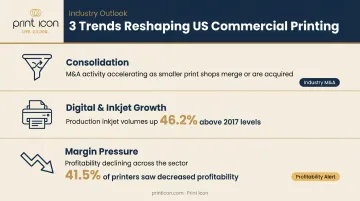
Three trends are reshaping the competitive landscape right now:
- Consolidation — Private equity firms and strategic buyers are acquiring smaller printers, concentrating volume among fewer large operators
- Digital and inkjet growth — Production inkjet adoption continues to accelerate globally, with Smithers reporting inkjet value in 2022 was 46.2% above 2017 levels (global figure)
- Margin pressure — Only 36.4% of surveyed printers saw increased pre-tax profitability in early 2023; 41.5% saw a decrease
These pressures have accelerated the separation between large-scale national operators and smaller regional players. The rankings below draw from the 2023 Printing Impressions 300 and reflect companies that have held or grown their position despite consolidation — measured by annual sales, service breadth, and national footprint.
Top Major Printing Companies in the United States (2023 Rankings)
The PI 300 ranks US and Canadian printers by annual sales — figures are generally self-reported and typically represent prior calendar-year revenue. Estimated figures (marked "E") use third-party sources such as Dun & Bradstreet. Rankings reflect scale, not universal quality or buyer fit.
RR Donnelley & Sons Company (RRD) — PI 300 Rank: #1
Founded in 1864 and headquartered in Illinois, RRD has held the top PI 300 position for four consecutive decades. Following its 2016 separation into three independent entities (RRD, LSC Communications, and Donnelley Financial Solutions), the core RRD business continues to lead the US market by annual sales. It is now privately held under Chatham Asset Management.
| Category | Details |
|---|---|
| Key Services | Commercial printing, direct mail, packaging, digital print, supply chain management, labels |
| Annual Revenue (approx.) | $5.3867B (2023 PI 300 ranking sales; FY2022 net sales $5.37B) |
| Notable Strength | 160+ years in operation; #1 on PI 300 for 40 consecutive years |
RRD's global facility network enables it to serve high-volume accounts in healthcare, financial services, and packaging. Its supply chain solutions extend beyond print into fulfillment and logistics, making it a full-service production partner for large enterprise clients.
Quad/Graphics, Inc. (NYSE: QUAD) — PI 300 Rank: #2
Founded in 1971 and headquartered in Sussex, Wisconsin, Quad has evolved from a commercial printer into what it describes as a marketing experience company. The business integrates creative services, media planning, data analytics, and print production into a single platform.
| Category | Details |
|---|---|
| Key Services | Commercial printing, direct mail, marketing services, packaging, in-store marketing, agency solutions |
| Annual Revenue (approx.) | $2.9633B (FY2023 net sales; down from $3.2205B in FY2022) |
| Notable Strength | Publicly traded; integrated marketing + print model serving retail, publishing, and healthcare |
Quad's appeal to brands managing complex, multi-channel campaigns lies in that integration. Net debt declined $564M (55%) between January 2020 and December 2023, and year-end leverage reached 2.0x — a significantly improved balance sheet that strengthens its long-term position.
Cimpress plc (Vistaprint) — PI 300 Rank: #3
Founded in 1995 and incorporated in Ireland, Cimpress operates Vistaprint and a portfolio of mass customization businesses. Its model differs fundamentally from traditional commercial printers: rather than handling large standardized runs for enterprise clients, it collects millions of small, individually customized orders through its automated Mass Customization Platform.
| Category | Details |
|---|---|
| Key Services | Custom business cards, marketing materials, signage, apparel, packaging, promotional gifts |
| Annual Revenue (approx.) | $3.0796B (FY2023, year ended June 30, 2023; NASDAQ: CMPR) |
| Notable Strength | Mass customization platform enabling near-production-scale efficiency on individual small orders |
Routing individually customized jobs through automated production and delivery is what separates Cimpress from both traditional large printers and boutique specialty shops. Small businesses get online ordering with near-volume pricing — a combination neither category has historically offered.
Taylor Corporation — PI 300 Rank: #6
Headquartered in North Mankato, Minnesota, Taylor is one of the largest privately held printing and marketing companies in the US. It runs a portfolio of subsidiary companies targeting specific verticals, each operating with relative independence under the Taylor umbrella.
| Category | Details |
|---|---|
| Key Services | Commercial printing, promotional products, marketing services, business forms, financial and healthcare communications |
| Annual Revenue (approx.) | $2.2B estimated (2023 PI 300; estimate based on D&B and third-party sources) |
| Notable Strength | Active M&A strategy; portfolio of subsidiaries spanning multiple industry verticals |
Taylor has acquired hundreds of graphic-arts companies over 45 years, making M&A a core growth mechanism rather than an occasional strategic move. Decades of acquisitions built reach across financial services documents, healthcare communications, promotional products, and business forms — verticals where specialized expertise matters more than raw production volume.
The Vomela Companies — PI 300 Rank: #21
Founded in 1947 and headquartered in St. Paul, Minnesota, Vomela operates a 24-location North American network specializing in large-format and specialty graphics. It serves retail, healthcare, automotive, and transportation clients — a niche that general commercial printers rarely cover well.
Ranked #21 on the PI 300, Vomela earns its place on this list for the depth of its specialty capabilities rather than raw revenue scale.
| Category | Details |
|---|---|
| Key Services | Large-format printing, vehicle and fleet wraps, environmental graphics, retail signage, custom displays |
| Annual Revenue (approx.) | $340M (2023 PI 300 self-reported ranking sales) |
| Notable Strength | End-to-end specialty graphics: design, prototyping, production, fabrication, and installation |
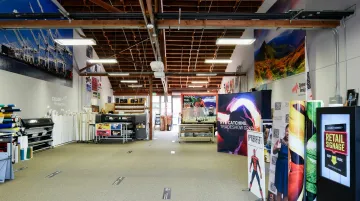
Its concept-through-installation model covers design, project management, fabrication, kitting, and field installation. That makes it the practical choice for brands managing fleet graphics programs, environmental buildouts, or large retail rollouts.
How We Chose the Best Printing Companies
How We Ranked the Top US Printers
Companies were assessed based on:
- Annual US sales — using the 2023 Printing Impressions 300 as the primary benchmark
- Operational scale — facilities, geographic coverage, production capacity
- Breadth of printing technologies — digital, offset, specialty, large-format
- Client base diversity — range of industries served
- Industry recognition — PI 300 ranking, publicly available financial reporting
Brand visibility and marketing presence were excluded as criteria. A company that spends heavily on advertising is not necessarily a better production partner than one that doesn't.
Common Buyer Mistakes
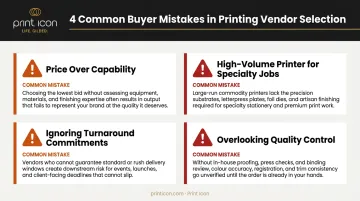
Selecting the wrong printing partner is a frequent and costly error. The most common missteps:
- Prioritizing price over capability fit — The cheapest quote rarely accounts for technique mismatch, quality failures, or reprints
- Choosing high-volume printers for specialty jobs — Mass production facilities are optimized for standardized runs, not for letterpress, engraving, foil stamping, or embossing; these techniques require different equipment, expertise, and proofing processes
- Ignoring turnaround commitments — Large printers work on their production schedules, not yours; specialty and local printers often offer next-business-day hard copy proofs and genuine rush order flexibility
- Overlooking quality control processes — Ask specifically whether physical proofs are available before full production begins
For businesses in the NY/NJ/CT/Boston area, Print Icon offers an alternative worth noting: a fully in-house model covering digital, offset, letterpress, engraving, foil stamping, thermography, embossing, diecutting, and laser cutting. Hard copy proofs are available the next business day, and walk-in consultations are welcome at both the NYC and Fairview, NJ locations during business hours.
Key Selection Criteria
Weight these factors according to your project's requirements:
- FSC certification — Confirms responsible paper sourcing; Print Icon's stock meets FSC guidelines for responsibly harvested paper
- Technology investment — Digital vs. offset vs. specialty; not every printer offers all three
- Client support model — Dedicated account reps, hard copy proofs, and rush capabilities vary significantly
- Minimum order requirements — Large commercial printers often have minimums that make small or custom runs impractical
Conclusion
The 2023 US printing landscape spans a wide spectrum. RRD and Quad manage billions in annual production across standardized commercial formats. Cimpress aggregates small customized orders through software at scale. Taylor expands through acquisition across targeted verticals. Vomela concentrates on specialty visual execution from concept through installation.
That scale works well for high-volume standardized jobs — but none of these are the right fit for a brand that needs 500 engraved invitations, letterpress business cards, or foil-stamped wedding suites produced with hands-on consultation and physical proofing.
Before finalizing a printing partner, assess:
- Whether the printer's core technology matches your required output format
- What their proofing process looks like — and whether physical proofs are available
- Their actual turnaround commitments for your order type
- Sustainability certifications relevant to your sourcing requirements
- Minimum quantities and whether small or custom runs are genuinely supported
For businesses in New York, New Jersey, Connecticut, or the Boston area seeking premium, fully custom printing — from digital and offset to letterpress, engraving, and foil stamping — Print Icon offers free quotes and walk-in consultations at its NYC location (134 West 20th Street, New York, NY 10011) and Fairview, NJ location (132 Bergen Boulevard). Reach them at 212-255-4489 (NY) or 201-366-4151 (NJ), Monday through Friday, 10am–6pm.
Frequently Asked Questions
What is the largest printing company in the United States?
RR Donnelley & Sons (RRD) has held the #1 position on the Printing Impressions 300 ranking for four consecutive decades, reporting approximately $5.4B in annual sales. The company is currently privately held by investment adviser Chatham Asset Management following its 2016 corporate separation.
What is the difference between commercial printing and custom printing?
Commercial printing covers high-volume, standardized production — catalogs, direct mail, books, packaging — optimized for efficiency at scale. Custom printing means tailored, specialty output (letterpress, engraving, foil stamping) with close attention to individual project specs, paper selection, and finishing requirements.
How do I choose the right printing company for my business?
Match your criteria to your project's needs: volume, required techniques, sustainability requirements, and turnaround time. Evaluate the printer's in-house capabilities, certification status, and client support model — not just brand size. A large commercial printer is rarely the right fit for specialty or premium custom work.
What printing technologies do major US printing companies use?
The primary methods are digital printing, offset lithography, and production inkjet for high-volume work, plus large-format printing for signage and graphics. Specialty providers also offer letterpress, engraving, thermography, foil stamping, embossing, diecutting, and laser cutting for premium or custom applications.
Are major US printing companies adopting sustainable practices?
FSC chain-of-custody certification allows printers to make FSC claims on eligible finished products and signals responsible paper sourcing. Look for FSC certification alongside recycled substrate offerings and energy-efficient processes when evaluating vendors.
What should I consider when choosing a local printer vs. a large national printing company?
Large national printers handle high-volume, standardized runs with efficient pricing at scale but limited flexibility for custom or specialty work. Local full-service printers offer hands-on consultation, faster turnarounds on bespoke jobs, physical proofing, and access to specialty techniques — making them the better fit for premium, one-of-a-kind, or craft-level print projects.