Introduction
A physical birthday card sent to a C-suite executive carries weight that no email or digital greeting can replicate. According to Hallmark Business, 64% of people feel genuinely special receiving a greeting card, compared to just 15% for email. In senior business relationships, that gap is the difference between a forgettable gesture and a lasting impression.
The real challenge is context. Standard retail cards skew casual — balloon graphics, playful fonts, punchlines that land awkwardly in a professional setting. For a board member, a major client, or a C-suite colleague, those choices undercut the very relationship you're trying to strengthen.
This guide covers the five best premium embossed birthday card styles for executive recipients, explains what separates executive-grade cards from standard options, and breaks down how the key printing techniques — embossing, engraving, foil stamping, thermography, and letterpress — differ in formality, cost, and tactile impact.
Key Takeaways
- Executive-grade birthday cards depend on paper weight, printing technique, design restraint, and finish — not just visual appeal
- C-suite recipients respond best to restrained palettes, metallic foil accents, and formal print processes
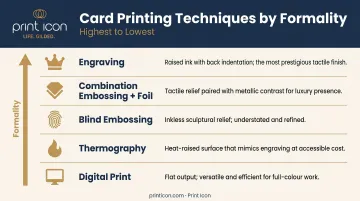
- Printing technique formality runs: engraving > blind or combination embossing > thermography > digital
- Customization — a company logo or handwritten note — converts a premium card into a relationship-building tool
- Print Icon's New York and New Jersey locations offer walk-in consultations to review paper and print samples in person
What Makes a Business Birthday Card "Executive-Grade"?
Not every premium-looking card is appropriate for a senior recipient. Executive-grade means a specific combination of material quality, printing technique, and tonal fit.
The Technical Standard
Paper weight is the starting point. For embossed or engraved cards, a minimum of 100 lb cover stock (270 gsm) provides sufficient fiber density to hold a die impression without softening. For deep blind embossing or letterpress, 110–120 lb cover (297 gsm+) or cotton stock is preferable — Neenah's cotton papers, for example, are available at 90 lb and 110 lb cover, compatible with embossing, engraving, foil, and letterpress.
Beyond weight, the printing technique signals intent:
- Engraving — the most formal option, with raised ink and a back-of-card indentation
- Combination embossing + foil stamping — visually striking, broadly appropriate for senior relationships
- Blind embossing — inkless, purely tactile; signals restraint and deliberate craft
- Thermography — raised print effect at practical volume cost
- Digital print — fine for internal cards, but reads as low-effort for C-suite recipients
The Tonal Standard
The design itself must match the technique. As the Gallery Collection notes, "business birthday cards shouldn't make either sender or receiver seem like the brunt of a joke."
Age jokes, cartoon imagery, and novelty themes may work between close friends — they undermine the professional impression you're building with a senior recipient.
What most buyers get wrong:
- Choosing lightweight stock that can't hold embossed detail — the relief flattens or tears at the edges
- Selecting visually busy designs where foil, color, and motifs compete rather than complement
- Using playful themes (balloon clusters, tiered cakes) that signal insufficient consideration of the recipient's seniority
- Ordering from generic templates that can't accommodate a company logo or personalized interior message
The right executive card is celebratory, warm, and calibrated to the relationship — not a novelty item dressed up in quality paper.
The Best Premium Embossed Business Birthday Cards for Executives
These five card styles represent the strongest options for executive recipients, evaluated on formality, tactile quality, customization potential, and lasting impression. Print Icon produces all five in-house across its New York City and Fairview, NJ locations.
1. Gold Foil Banner + Embossed Text Card
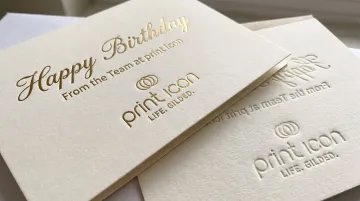
A heavy ecru or cream matte card stock featuring a raised embossed motif — a classic banner, stars, or a decorative border — combined with gold foil lettering that shifts in the light. Theater-marquee impact, executive-level restraint.
Gold foil is the most broadly recognized premium finish across industries and demographics. Paired with tactile embossing on heavy stock, it communicates care and investment without leaning into color or imagery that might feel too festive.
| Spec | Detail |
|---|---|
| Card Stock | Minimum 100 lb cover, ecru or cream matte for strong foil contrast |
| Printing Technique | Combination embossing + gold or champagne foil stamping |
| Best For | Senior client relationships, board members, long-tenured colleagues |
2. Blind Emboss on Premium Matte Stock Card
Heavy, inkless card stock — a monogram, geometric border, or abstract motif pressed into the paper so the relief is visible only through shadow and touch. No color, no foil — nothing but the impression.
Blind embossing is the most restrained of all premium finishes, and in finance, law, and luxury sectors, that restraint reads as authority. It's also the most enduring — it won't look dated in five years.
| Spec | Detail |
|---|---|
| Card Stock | 120 lb+ uncoated or cotton stock to hold deep relief without softening |
| Printing Technique | Blind embossing only — no ink, no foil |
| Best For | Highest-formality professional settings; industries where understatement signals status |
3. Engraved Card with Metallic Ink Lettering
An inked copper die pressed into crisp white or ivory heavy stock, leaving raised ink on the front and a faint indentation on the reverse — the sharpest text edge achievable in print. Paired with charcoal, navy, or metallic ink, the result is black-tie-event quality.
Crane describes engraving as the premier printing process for fine stationery — historically used for presidential inaugural invitations and official correspondence. For a CEO, board chair, or major client, this choice communicates that you consider the occasion genuinely significant.
| Spec | Detail |
|---|---|
| Card Stock | Crisp white or ivory, minimum 110 lb uncoated to reveal engraving depth |
| Printing Technique | Die engraving with metallic, charcoal, or navy ink; optional blind emboss border |
| Best For | Highest-formality scenarios: major clients, C-suite at partner organizations |
4. Thermographic Raised Print + Foil Accent Card
Heat-fused powder over wet ink creates a raised, glossy printed surface that closely mirrors engraved text. Combined with a foil stamped accent — a gold border, a star motif, a small logo — it delivers a premium tactile experience with strong visual impact.
Thermography is the most practical premium option for teams managing multiple executive birthdays across the year. Why it works at scale:
- Raised-print finish delivers substantially more presence than flat digital print
- Lower per-card cost than engraving, without sacrificing perceived quality
- Foil accent elements keep the look appropriately formal for senior recipients
| Spec | Detail |
|---|---|
| Card Stock | 80–100 lb matte or linen-textured stock; avoid high-gloss bases |
| Printing Technique | Thermographic raised print + foil stamping for accent elements |
| Best For | Corporate teams sending multiple executive birthday cards annually |
5. Letterpress with Foil Stamped Motif Card
A plate pressed into soft, thick paper creates a debossed impression — the inverse of embossing, where the design sinks into the card rather than rising from it. Combined with a foil stamped botanical motif, abstract geometric, or monogram, the result is unmistakably handcrafted.
For an executive in design, media, luxury goods, or the arts, a letterpress card signals that the sender made a considered, personalized choice — not a volume purchase. The physical depth of the impression — only possible on thick cotton or felt stock — is something recipients notice and remember in a way that flat-printed cards simply cannot replicate.
| Spec | Detail |
|---|---|
| Card Stock | Thick soft-cotton or felt stock (220 gsm+), cream or natural white |
| Printing Technique | Letterpress for primary text/motif + gold or silver foil stamping |
| Best For | Creative industries, luxury brands, recipients who value craftsmanship |
Embossing vs. Other Premium Printing Techniques
Understanding the differences helps you match the technique to the relationship and context.
The Core Techniques Defined
Embossing uses a metal die pressed from below to raise the design above the paper surface, requiring no ink. The result is three-dimensional and purely tactile. Combined with foil or ink, it becomes combination embossing — a finish that pairs visual contrast with physical texture in a way few other techniques match.
Debossing is the inverse: the die presses from above, sinking the design into the paper. Letterpress printing produces this same effect and is particularly effective on soft, thick cotton stock.
Engraving uses an etched copper plate filled with ink, pressed into the paper under extreme pressure. The ink transfers raised onto the front, leaving a faint indentation on the reverse. Per stationery authority Nancy Sharon Collins, engraving is the preferred technique for formal professional correspondence, including presidential inaugural invitations.
Thermography applies powder to wet ink and fuses it with heat, producing a raised surface similar in appearance to engraving, without the back indentation. A trained eye can distinguish the two, but for most executive recipients, thermography reads as genuinely premium.
Foil stamping uses heat and pressure to bond metallic or pigmented foil to a specific card area. Options range from classic gold and silver to champagne and holographic finishes, often layered over embossed or letterpress designs to add depth to an already tactile piece.
Matching Technique to Context
| Scenario | Recommended Technique |
|---|---|
| Board member, major client, highest formality | Engraving |
| Senior client or colleague, broad professional use | Combination embossing + foil |
| Finance, law, luxury — understatement preferred | Blind embossing |
| Multiple executive cards annually, volume efficiency | Thermography + foil accent |
| Creative, luxury, or design industry recipient | Letterpress + foil |
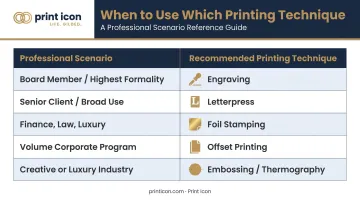
Choosing the right technique is easier when you can see and feel the result before committing. Print Icon offers all of these techniques in-house, with hard copy proofs available next business day for standard orders. For specialty techniques like engraving and foil stamping, digital proofs on final paper stock are available so you can assess quality before approving a full run.
Conclusion
For C-suite recipients, a physical birthday card is one of the few business gestures that registers as genuinely personal when most professional communication defaults to email or Slack. But the card only lands as intended if the execution matches the occasion. The weight of the stock in hand, the raised texture of an embossed motif, the way a gold foil accent catches light at an angle — these are the details that separate a memorable gesture from a forgettable one.
The technique matters. So does the stock. And so does the restraint to choose a design that acknowledges the occasion without crossing into territory that undercuts the professional relationship you've spent time building.
Print Icon produces fully custom embossed birthday cards for executives entirely in-house. Every order is built to spec, with options including:
- Premium card stocks in a range of weights and finishes
- Foil stamping, engraving, thermography, and letterpress printing
- Hard copy proofs available next business day
- Rush order fulfillment for time-sensitive occasions
Walk-in consultations are welcome at the New York location (134 West 20th Street) or the New Jersey location (132 Bergen Boulevard, Fairview), Monday through Friday, 10am–6pm. Reach out to request a free quote.
Frequently Asked Questions
How do you professionally say "happy birthday" to an executive?
Keep the message warm but brief (two to three sentences is appropriate). Acknowledge the occasion, express genuine well-wishes, and avoid humor unless you know the recipient well. A phrase like "Wishing you a wonderful birthday and a continued year of remarkable leadership" works across most professional contexts without veering too casual or too stiff.
What is the difference between embossed and engraved birthday cards?
Embossing raises the design above the paper surface using a die pressed from below (no ink required). Engraving uses a die pressed from above with ink, creating raised ink on the front and a faint indentation on the reverse — making it the more formal option and the traditional choice for black-tie-level stationery.
What card stock weight is recommended for premium executive birthday cards?
A minimum of 100 lb cover stock (270 gsm) is recommended for most executive-grade cards. For deep blind embossing or letterpress, 110–120 lb cover or cotton stock is preferable because heavier, more porous papers hold die impressions more deeply and produce a more pronounced tactile effect.
Should executive birthday cards be hand-signed, or is a printed interior message acceptable?
For senior or high-value relationships, a handwritten signature (and ideally a brief personal note) significantly increases the perceived thoughtfulness of the gesture. A printed interior is acceptable for volume programs, but always worth upgrading for individual executive relationships.
Can embossed business birthday cards be customized with a company logo?
Yes. A full-service printer can incorporate a company logo as a blind-embossed element on the card back, a foil stamped mark on the interior, or a combination of both. Tasteful logo placement adds brand recognition without making the card feel like a marketing piece.
What printing technique is best for a first-time birthday card to an executive client?
Combination embossing with a gold foil accent on heavy matte or ecru stock is the safest premium choice. It reads as universally formal across industries, avoids the risk of appearing too casual or too avant-garde, and works equally well regardless of the recipient's gender or sector.